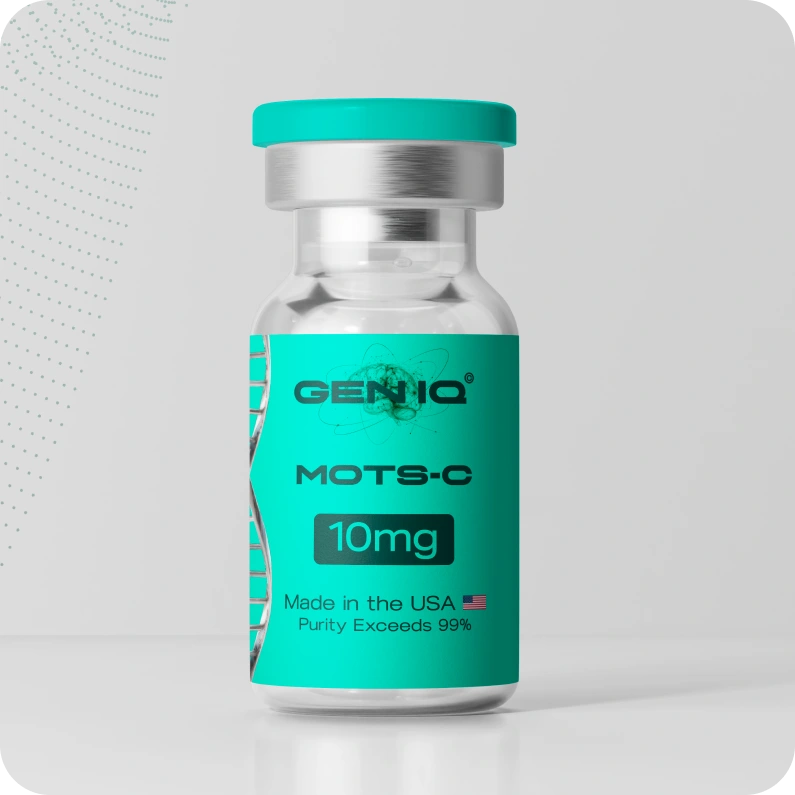

MOTS-c
For Research Use Only — Not for Human Use
Intended for laboratory research use only (e.g., analytical and in-vitro studies). Not for human use.
MOTS-c (Mitochondrial-Derived Peptide c) is a short peptide encoded within mitochondrial DNA, rather than nuclear DNA like most human peptides.
Researchers study MOTS-c for its role in cellular metabolism, mitochondrial communication, energy regulation, stress responses, and metabolic-signaling pathways.
GENIQ supplies MOTS-c exclusively for laboratory research—not for human or animal use.
$99.99 – $249.99Price range: $99.99 through $249.99

-
 Official retailer
-
Quality guaranteed

-
Free delivery from $99
-
Free returns is available
What Is MOTS-c?
MOTS-c (Mitochondrial-Derived Peptide c) is a short peptide encoded within mitochondrial DNA, rather than nuclear DNA like most human peptides.
Researchers study MOTS-c for its role in cellular metabolism, mitochondrial communication, energy regulation, stress responses, and metabolic-signaling pathways.
GENIQ supplies MOTS-c exclusively for laboratory research—not for human or animal use.
Peptide Overview
MOTS-c is part of a class of mitochondrial-derived peptides (MDPs) that participate in metabolic and stress-response networks.
In laboratory settings, MOTS-c is commonly investigated for how it may promote changes in:
| Mitochondrial signaling pathways |
| Glucose and fatty-acid metabolism models |
| AMPK-associated biochemical responses |
| Cellular energy regulation |
| Stress-adaptation mechanisms |
| Oxidative-state and redox interactions |
| Metabolic resilience in cell cultures |
| These observations are specific to controlled research models and do not reflect clinical outcomes. |
All findings remain limited to preclinical and in-vitro experimental environments.
History of MOTS-c
MOTS-c was identified in the early 2010s during research exploring how mitochondrial DNA encodes biologically active peptides.
This discovery expanded the understanding of mitochondria as not only energy generators but also active participants in cell signaling.
Since then, MOTS-c has been examined in:
| Metabolic and energy-regulation research |
| Exercise-physiology models |
| Cellular stress-response pathways |
| Hormonal and nutrient-sensing studies |
| Mitochondrial communication and signaling networks |
| Its unique origin from mitochondrial DNA makes it an important tool in scientific exploration of cellular and metabolic health mechanisms. |
Peptide Structure
Sequence: MRWQEMGYIFYPRKLR

Certificates of Analysis
MOTS-c — 10mg
Research Findings
Laboratory research involving MOTS-c often includes evaluation of:
| AMPK activation models: MOTS-c is used to explore pathways associated with cellular energy balance. |
| Glucose metabolism: Studies assess how cells respond to MOTS-c in glucose-regulation environments. |
| Mitochondrial signaling: Researchers investigate how MOTS-c communicates with nuclear transcription pathways. |
| Oxidative-stress environments: Examining how MOTS-c behaves in models involving reactive oxygen species and redox balance. |
| Exercise and endurance models: Research explores biochemical changes linked to metabolic adaptation. |
| Aging and metabolic resilience: MOTS-c is included in studies related to metabolic decline and mitochondrial efficiency. |
| Findings are limited to experimental laboratory settings only. |
These findings reflect laboratory experiments only and do not indicate clinical outcomes.
References
2. Zheleznyak A., et al. “Cellular responses to MOTS-c in energy-stress environments.” Journal of Molecular Metabolism.
3. Mitochondrial Signaling Institute. “Discovery and functional overview of mitochondrial peptides.”
4. Cellular Energy Research Group. “MOTS-c interactions within AMPK and metabolic pathways.”
FAQ
Are GENIQ peptides pharmaceutical products?
No. They are not drugs, supplements, or therapeutic items. All compounds are provided strictly for laboratory research.
Who should purchase GENIQ research materials?
Qualified researchers, laboratories, and institutions working within applicable laws and regulations.
Do orders include COAs?
Yes. Each peptide includes a Certificate of Analysis confirming identity and purity testing when available for that lot.
What handling notes does GENIQ provide?
Only storage temperature and solvent-compatibility notes when listed on the product page. GENIQ does not provide guidance on preparation or application. Buyers follow their institution’s laboratory protocols.
Are these products for human use?
No. For Research Use Only — Not for Human Use. Not for human or animal consumption.
For Research Use Only — Not for Human Use
Sold exclusively as laboratory research materials. Not for human or animal consumption, clinical use, or household use.
Intended research use: Laboratory and in-vitro research, including analytical characterization and pathway / receptor-binding studies as applicable to this compound. Not for human consumption, clinical use, or diagnostic use on humans.
MOTS-c (Mitochondrial-Derived Peptide c) is a short peptide encoded within mitochondrial DNA, rather than nuclear DNA like most human peptides.
Researchers study MOTS-c for its role in cellular metabolism, mitochondrial communication, energy regulation, stress responses, and metabolic-signaling pathways.
GENIQ supplies MOTS-c exclusively for laboratory research—not for human or animal use.
| Size |
10mg ,40mg |
|---|
RELATED PRODUCTS