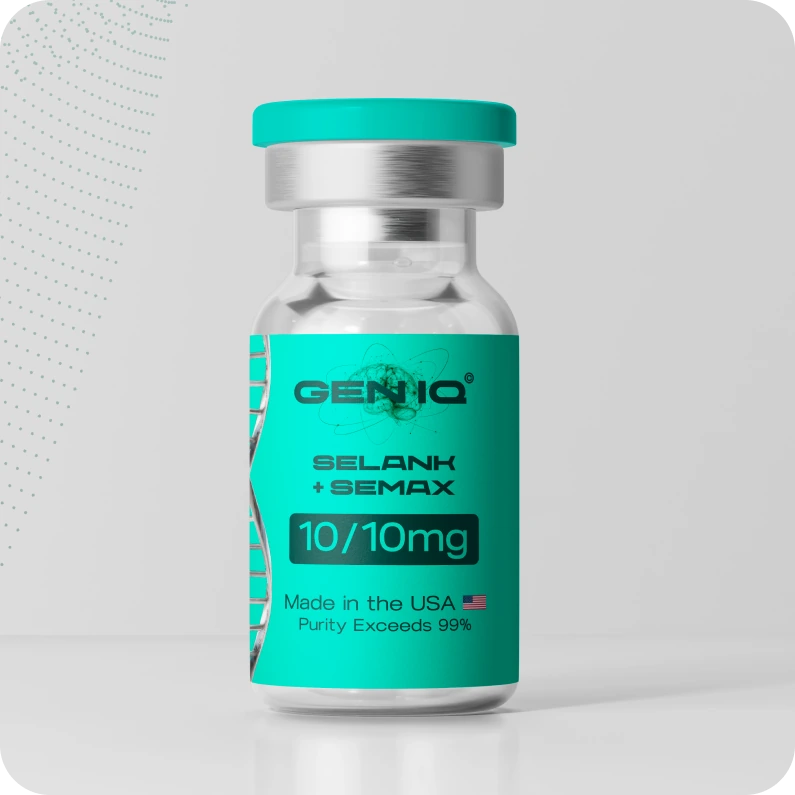
Selank + Semax (10/10mg)
For Research Use Only — Not for Human Use
Intended for laboratory research use only (e.g., analytical and in-vitro studies). Not for human use.
Selank + Semax is a dual-peptide research blend combining a synthetic analog of the immunomodulatory peptide tuftsin (Selank) with a synthetic analog of the ACTH(4-10) fragment (Semax).
Researchers use this combination to study neuropeptide signaling, neurotrophic-factor expression, and GABAergic and monoaminergic pathway modulation under controlled laboratory conditions.
This compound is provided by GENIQ exclusively for scientific research and not for human or animal use.
$199.99

-
 Official retailer
 -
Quality guaranteed

-
Free delivery from $99
-
Free returns is available
What Is Selank + Semax?
Selank + Semax is a synthetic peptide blend developed for research on neuropeptide signaling in the central nervous system.
Selank is a heptapeptide derived from tuftsin, a naturally occurring fragment of immunoglobulin G, extended with a Pro-Gly-Pro sequence for stability. Semax is a heptapeptide analog of the ACTH(4-10) fragment, also stabilized with a C-terminal Pro-Gly-Pro motif.
Researchers use this blend to investigate neurotrophic-factor expression, GABA-receptor modulation, and neuropeptide-mediated gene-expression changes in cellular and preclinical models.
GENIQ provides this compound solely for controlled laboratory research, not for human or animal use.
Peptide Overview
This blend merges two peptides commonly used in neuroscience research:
Selank:
A tuftsin-analog heptapeptide studied for its influence on GABAergic neurotransmission, enkephalin-degrading enzyme activity, and cytokine-expression models.
Semax:
An ACTH(4-10) analog investigated for its effects on BDNF and TrkB expression, monoaminergic signaling, and neuronal-survival models in vitro.
| Laboratory studies evaluate how this peptide combination may influence: |
| • BDNF and neurotrophin-receptor expression |
| • GABA-receptor subunit expression and GABAergic signaling |
| • Enkephalin-degrading enzyme activity |
| • Neuropeptide-mediated gene-expression patterns in preclinical models |
| These findings are strictly from research environments. |
All findings remain limited to preclinical and in-vitro experimental environments.
History of Selank + Semax
Semax was developed in Russia during the 1980s at the Institute of Molecular Genetics as a stabilized analog of the ACTH(4-10) fragment, retaining the fragment’s neuropeptide activity while removing hormonal effects associated with the full ACTH sequence.
Selank followed from the same research program in the 1990s, applying the Pro-Gly-Pro stabilization approach to tuftsin, an immunomodulatory tetrapeptide.
Researchers began pairing these peptides to investigate how two structurally related, stabilized neuropeptides act on overlapping neurotrophic and neurotransmitter pathways. The combination remains of interest for in-vitro and preclinical examination of neuropeptide signaling.
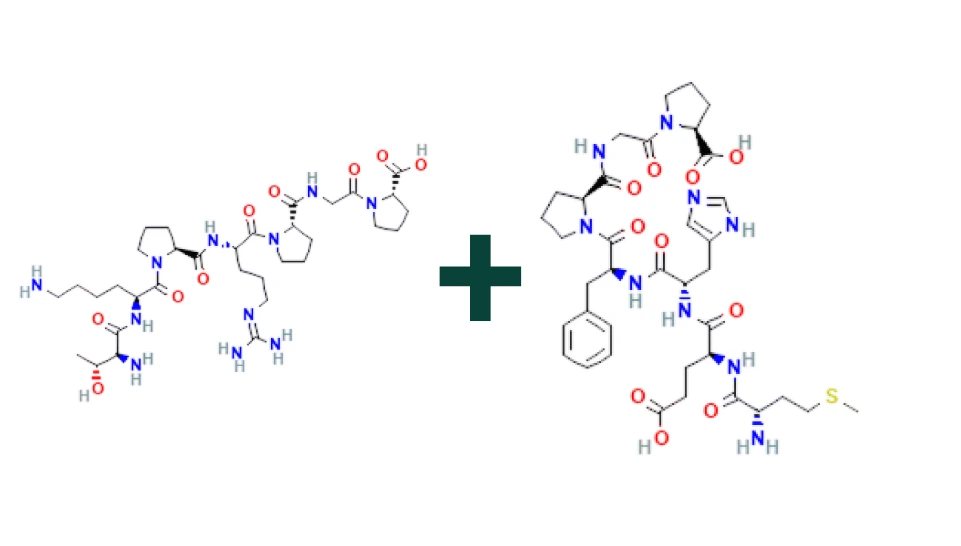
Peptide Structure
Selank Sequence:
Thr-Lys-Pro-Arg-Pro-Gly-Pro
Molecular Formula: C33H57N11O9
Semax Sequence:
Met-Glu-His-Phe-Pro-Gly-Pro
Molecular Formula: C37H51N9O10S
Certificates of Analysis
Selank + Semax (10mg / 10mg)
Research Findings
Research models analyzing the dual activity of Selank and Semax commonly explore:
| • Neurotrophic signaling: Measuring changes in BDNF and TrkB expression following peptide exposure in cellular models. |
| • GABAergic modulation: Examining Selank-related changes in GABA-receptor subunit expression. |
| • Gene-expression profiling: Investigating transcriptomic responses in hippocampal and immune-cell models. |
| • Neuropeptide stability: Comparing degradation kinetics of Pro-Gly-Pro stabilized peptides in vitro. |
| These data represent controlled in-vitro and preclinical studies, not clinical outcomes. |
These findings reflect laboratory experiments only and do not indicate clinical outcomes.
References
FAQ
Are GENIQ peptides pharmaceutical products?
No. They are not drugs, supplements, or therapeutic items. All compounds are provided strictly for laboratory research.
Who should purchase GENIQ research materials?
Qualified researchers, laboratories, and institutions working within applicable laws and regulations.
Do orders include COAs?
Yes. Each peptide includes a Certificate of Analysis confirming identity and purity testing when available for that lot.
What handling notes does GENIQ provide?
Only storage temperature and solvent-compatibility notes when listed on the product page. GENIQ does not provide guidance on preparation or application. Buyers follow their institution’s laboratory protocols.
Are these products for human use?
No. For Research Use Only — Not for Human Use. Not for human or animal consumption.
For Research Use Only — Not for Human Use
Sold exclusively as laboratory research materials. Not for human or animal consumption, clinical use, or household use.
Intended research use: Laboratory and in-vitro research, including analytical characterization and pathway / receptor-binding studies as applicable to this compound. Not for human consumption, clinical use, or diagnostic use on humans.
Selank + Semax is a dual-peptide research blend combining a synthetic analog of the immunomodulatory peptide tuftsin (Selank) with a synthetic analog of the ACTH(4-10) fragment (Semax).
Researchers use this combination to study neuropeptide signaling, neurotrophic-factor expression, and GABAergic and monoaminergic pathway modulation under controlled laboratory conditions.
This compound is provided by GENIQ exclusively for scientific research and not for human or animal use.
RELATED PRODUCTS
MOTS-c
$99.99 – $249.99Price range: $99.99 through $249.99