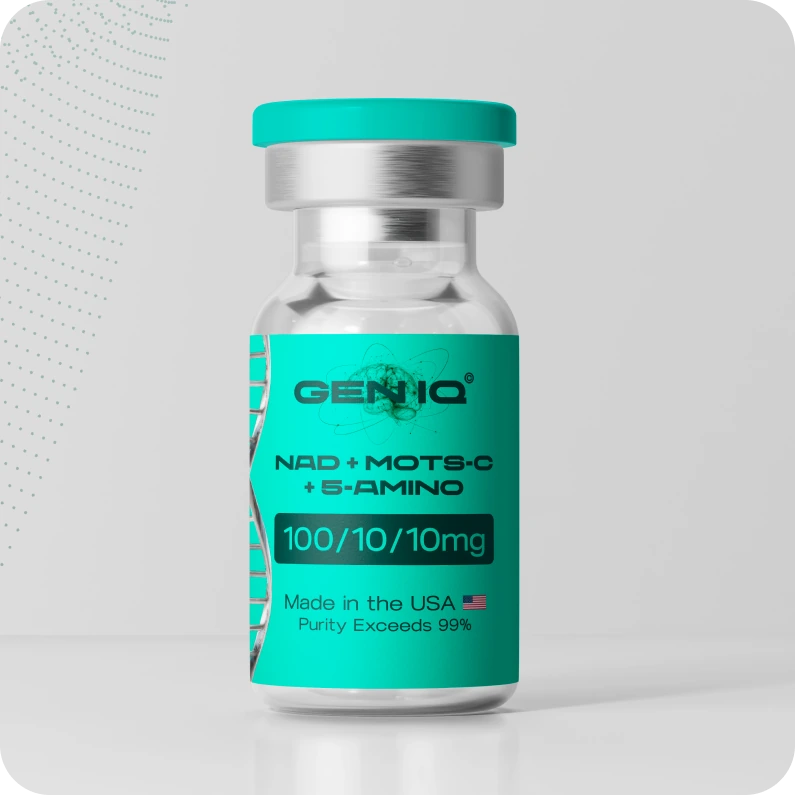
NAD+ / MOTS-c / 5-Amino-1MQ (100mg / 10mg / 10mg)
For Research Use Only — Not for Human Use
Intended for laboratory research use only (e.g., analytical and in-vitro studies). Not for human use.
NAD+ / MOTS-c / 5-Amino-1MQ is a triple-compound research blend combining a central redox coenzyme (NAD+), a mitochondrial-derived peptide (MOTS-c), and a small-molecule NNMT inhibitor (5-Amino-1MQ).
Researchers use this combination to study mitochondrial function, cellular energy metabolism, and NAD+-dependent signaling under controlled laboratory conditions.
This compound is provided by GENIQ exclusively for scientific research and not for human or animal use.
$249.99

-
 Official retailer
 -
Quality guaranteed

-
Free delivery from $99
-
Free returns is available
What Is NAD+ / MOTS-c / 5-Amino-1MQ?
NAD+ / MOTS-c / 5-Amino-1MQ is a research blend designed for studies on mitochondrial biology and cellular energy metabolism.
NAD+ (nicotinamide adenine dinucleotide) is a coenzyme central to redox reactions and sirtuin activity. MOTS-c is a 16-amino-acid peptide encoded within mitochondrial DNA that participates in metabolic-stress signaling. 5-Amino-1MQ is a small molecule that inhibits nicotinamide N-methyltransferase (NNMT), an enzyme involved in NAD+ precursor consumption.
Researchers use this blend to investigate how NAD+ availability, mitochondrial signaling, and NNMT inhibition interact in cellular models of energy homeostasis.
GENIQ provides this compound solely for controlled laboratory research, not for human or animal use.
Peptide Overview
This blend merges three compounds commonly used in mitochondrial and metabolic research:
NAD+:
A redox coenzyme studied for its role in electron transport, sirtuin and PARP activity, and cellular energy-metabolism models.
MOTS-c:
A mitochondrial-derived peptide investigated for AMPK-pathway signaling, folate-cycle regulation, and metabolic-stress responses in cellular models.
5-Amino-1MQ:
A selective NNMT inhibitor studied for its influence on NAD+ salvage pathways, methylation balance, and adipocyte metabolism in vitro.
| Laboratory studies evaluate how this compound combination may influence: |
| • NAD+/NADH ratio and sirtuin-dependent signaling |
| • AMPK activation and mitochondrial biogenesis markers |
| • NNMT activity and one-carbon metabolism |
| • Cellular energy-metabolism pathways in preclinical models |
| These findings are strictly from research environments. |
All findings remain limited to preclinical and in-vitro experimental environments.
History of NAD+ / MOTS-c / 5-Amino-1MQ
NAD+ was identified in the early twentieth century as a coenzyme in fermentation and has since become one of the most studied molecules in cellular metabolism, particularly in relation to sirtuin biology and age-related changes in NAD+ levels.
MOTS-c was described in 2015 as a peptide encoded within the mitochondrial 12S rRNA gene, opening a new field of research on mitochondrial-derived peptides and their role in metabolic signaling.
5-Amino-1MQ emerged from medicinal-chemistry programs seeking selective, membrane-permeable NNMT inhibitors. Researchers began combining these three compounds to examine complementary approaches to NAD+ metabolism and mitochondrial function within a single experimental framework.
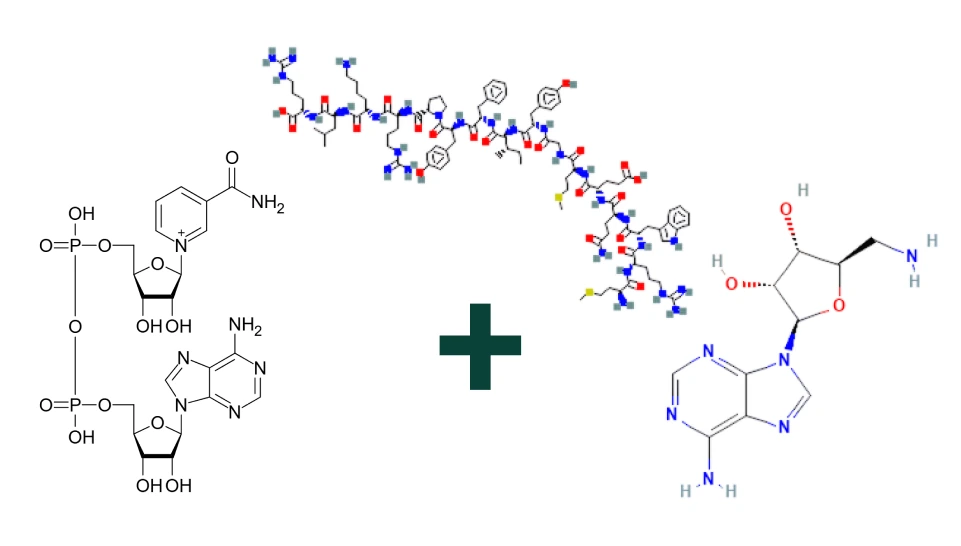
Peptide Structure
NAD+:
Molecular Formula: C21H27N7O14P2
MOTS-c Sequence:
Met-Arg-Trp-Gln-Glu-Met-Gly-Tyr-Ile-Phe-Tyr-Pro-Arg-Lys-Leu-Arg
5-Amino-1MQ:
5-Amino-1-methylquinolinium
Molecular Formula: C10H11N2+
Certificates of Analysis
NAD+ / MOTS-c / 5-Amino-1MQ (100mg / 10mg / 10mg)
Research Findings
Research models analyzing the combined activity of NAD+, MOTS-c, and 5-Amino-1MQ commonly explore:
| • NAD+ metabolism: Measuring changes in NAD+ availability, salvage-pathway flux, and sirtuin activity. |
| • Mitochondrial signaling: Examining MOTS-c-mediated AMPK activation and metabolic-stress responses in cellular models. |
| • NNMT inhibition: Investigating how reduced nicotinamide methylation affects methyl-donor balance and adipocyte metabolism. |
| • Cellular energetics: Assessing oxygen consumption, ATP production, and mitochondrial biogenesis markers in vitro. |
| These data represent controlled in-vitro and preclinical studies, not clinical outcomes. |
These findings reflect laboratory experiments only and do not indicate clinical outcomes.
References
FAQ
Are GENIQ peptides pharmaceutical products?
No. They are not drugs, supplements, or therapeutic items. All compounds are provided strictly for laboratory research.
Who should purchase GENIQ research materials?
Qualified researchers, laboratories, and institutions working within applicable laws and regulations.
Do orders include COAs?
Yes. Each peptide includes a Certificate of Analysis confirming identity and purity testing when available for that lot.
What handling notes does GENIQ provide?
Only storage temperature and solvent-compatibility notes when listed on the product page. GENIQ does not provide guidance on preparation or application. Buyers follow their institution’s laboratory protocols.
Are these products for human use?
No. For Research Use Only — Not for Human Use. Not for human or animal consumption.
For Research Use Only — Not for Human Use
Sold exclusively as laboratory research materials. Not for human or animal consumption, clinical use, or household use.
Intended research use: Laboratory and in-vitro research, including analytical characterization and pathway / receptor-binding studies as applicable to this compound. Not for human consumption, clinical use, or diagnostic use on humans.
NAD+ / MOTS-c / 5-Amino-1MQ is a triple-compound research blend combining a central redox coenzyme (NAD+), a mitochondrial-derived peptide (MOTS-c), and a small-molecule NNMT inhibitor (5-Amino-1MQ).
Researchers use this combination to study mitochondrial function, cellular energy metabolism, and NAD+-dependent signaling under controlled laboratory conditions.
This compound is provided by GENIQ exclusively for scientific research and not for human or animal use.
RELATED PRODUCTS