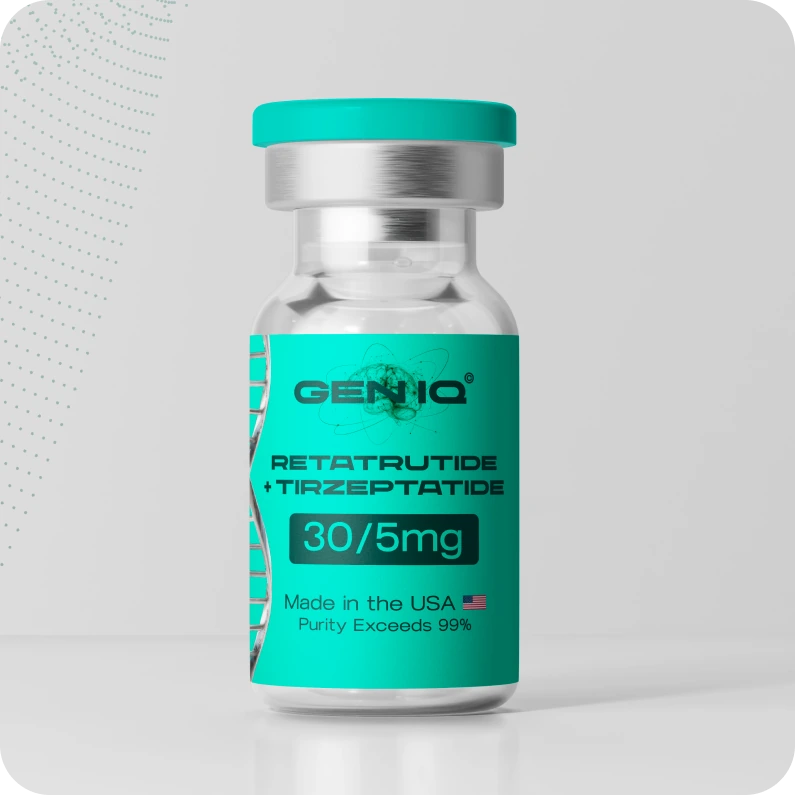



Retatrutide / Tirzepatide (30mg / 5mg)
Retatrutide / Tirzepatide is a dual-peptide research blend combining a GIP/GLP-1/glucagon triple-receptor agonist (Retatrutide) with a dual GIP/GLP-1 receptor agonist (Tirzepatide).
Researchers use this combination to study overlapping incretin, glucagon, and nutrient-sensing receptor signaling under controlled laboratory conditions.
This compound is provided by GENIQ exclusively for scientific research and not for human or animal use.
$379.99
-
Official retailer
-
Quality guaranteed
-
Free delivery from $99
-
Free returns is available
What Is Retatrutide / Tirzepatide?
Retatrutide / Tirzepatide is a synthetic peptide blend developed for research on multi-receptor metabolic signaling.
Retatrutide is engineered to engage GIP, GLP-1, and glucagon receptors simultaneously, while Tirzepatide is a dual GIP/GLP-1 receptor agonist. Both carry a fatty-diacid side chain that extends their duration within experimental systems.
Researchers use this blend to investigate combined incretin-receptor activation, glucose-regulation models, and energy-balance pathways in vitro and in preclinical settings.
GENIQ provides this compound solely for controlled laboratory research, not for human or animal use.
Peptide Overview
This blend merges two peptides commonly used in metabolic signaling research:
Retatrutide:
A 39-amino-acid triple agonist studied for its simultaneous activity at GIP, GLP-1, and glucagon receptors and its influence on nutrient-sensing and energy-expenditure models.
Tirzepatide:
A 39-amino-acid dual GIP/GLP-1 receptor agonist investigated for incretin-pathway signaling, insulin-secretion modeling, and receptor-selectivity studies.
| Laboratory studies evaluate how this peptide combination may influence: |
| • Incretin-receptor activation and cAMP signaling |
| • Glucose-regulation and insulin-secretion models |
| • Glucagon-receptor-mediated energy-expenditure pathways |
| • Nutrient-sensing and appetite-signaling circuits in preclinical models |
| These findings are strictly from research environments. |
All findings remain limited to preclinical and in-vitro experimental environments.
History of Retatrutide / Tirzepatide
Tirzepatide emerged from efforts to combine GIP and GLP-1 receptor activity within a single molecule, building on earlier single-agonist incretin research. Its dual-receptor profile made it a widely used reference compound in metabolic studies.
Retatrutide was developed subsequently as a triple agonist, adding glucagon-receptor activity to the GIP/GLP-1 framework to explore whether a broader receptor profile changes energy-balance outcomes in experimental models.
Researchers began pairing the two compounds to compare dual versus triple incretin-receptor engagement within the same experimental framework. The combination remains of interest for in-vitro and preclinical examination of metabolic receptor signaling.
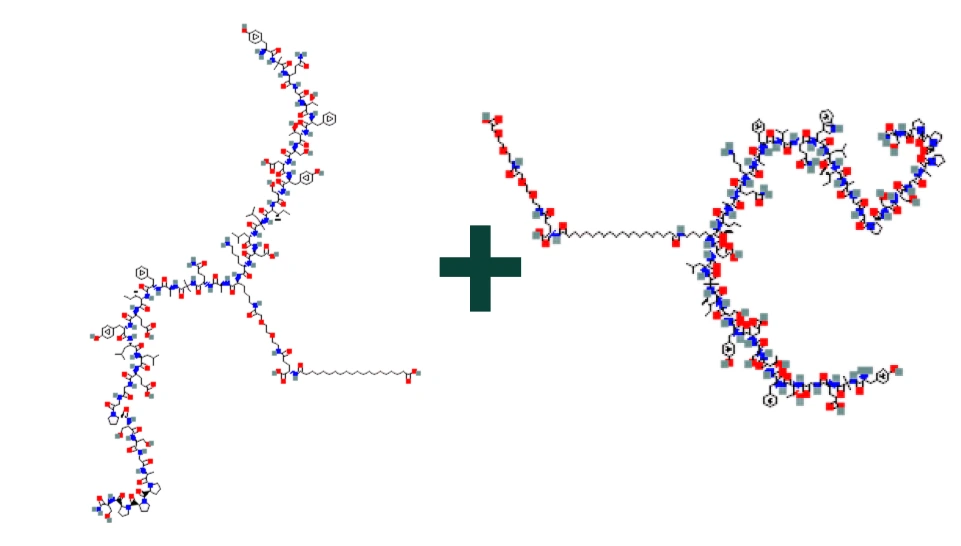
Peptide Structure
Retatrutide:
39-amino-acid GIP/GLP-1/glucagon receptor triple agonist with a C20 fatty-diacid side chain
Molecular Formula: C221H342N46O68
Tirzepatide:
39-amino-acid GIP/GLP-1 receptor dual agonist with a C20 fatty-diacid side chain
Molecular Formula: C225H348N48O68
Certificates of Analysis
Retatrutide / Tirzepatide (30mg / 5mg)
Research Findings
Research models analyzing the dual activity of Retatrutide and Tirzepatide commonly explore:
| • Multi-receptor incretin signaling: Comparing dual versus triple receptor engagement in the same experimental system. |
| • Glucose-regulation modeling: Examining insulin-secretion and glucose-disposal responses in preclinical models. |
| • Energy-balance pathways: Studying glucagon-receptor-mediated effects on energy expenditure and lipid metabolism in vitro. |
| • Receptor pharmacology: Investigating binding kinetics, cAMP accumulation, and downstream gene-expression changes. |
| These data represent controlled in-vitro and preclinical studies, not clinical outcomes. |
These findings reflect laboratory experiments only and do not indicate clinical outcomes.
References
2. Jastreboff A.M., et al. “Triple-Hormone-Receptor Agonist Retatrutide for Obesity: A Phase 2 Trial.” New England Journal of Medicine, 2023.
3. Coskun T., et al. “LY3298176, a novel dual GIP and GLP-1 receptor agonist for the treatment of type 2 diabetes mellitus: From discovery to clinical proof of concept.” Molecular Metabolism, 2018.
4. Frias J.P., et al. “Tirzepatide versus Semaglutide Once Weekly in Patients with Type 2 Diabetes.” New England Journal of Medicine, 2021.
FAQ
What type of research is this peptide blend used for?
It is used to study incretin and glucagon receptor signaling, glucose-regulation models, and energy-balance pathways.
Does GENIQ provide a Certificate of Analysis?
Yes. Every GENIQ peptide includes a COA verifying identity and purity.
Is this product approved for human or animal use?
No. It is not FDA-approved and not intended for human or veterinary administration.
Can GENIQ provide instructions regarding preparation or use?
No. GENIQ does not give any guidance related to reconstitution, dosing, or application.
Who should handle this compound?
Only trained laboratory researchers in controlled scientific environments.
Research Use Only
All GENIQ compounds are intended strictly for laboratory research.
Not for human or animal consumption, medical use, or therapeutic application.
Nothing in this document should be interpreted as medical advice or as approval for use outside controlled scientific environments.
Retatrutide / Tirzepatide is a dual-peptide research blend combining a GIP/GLP-1/glucagon triple-receptor agonist (Retatrutide) with a dual GIP/GLP-1 receptor agonist (Tirzepatide).
Researchers use this combination to study overlapping incretin, glucagon, and nutrient-sensing receptor signaling under controlled laboratory conditions.
This compound is provided by GENIQ exclusively for scientific research and not for human or animal use.
Only logged in customers who have purchased this product may leave a review.

Reviews
There are no reviews yet.