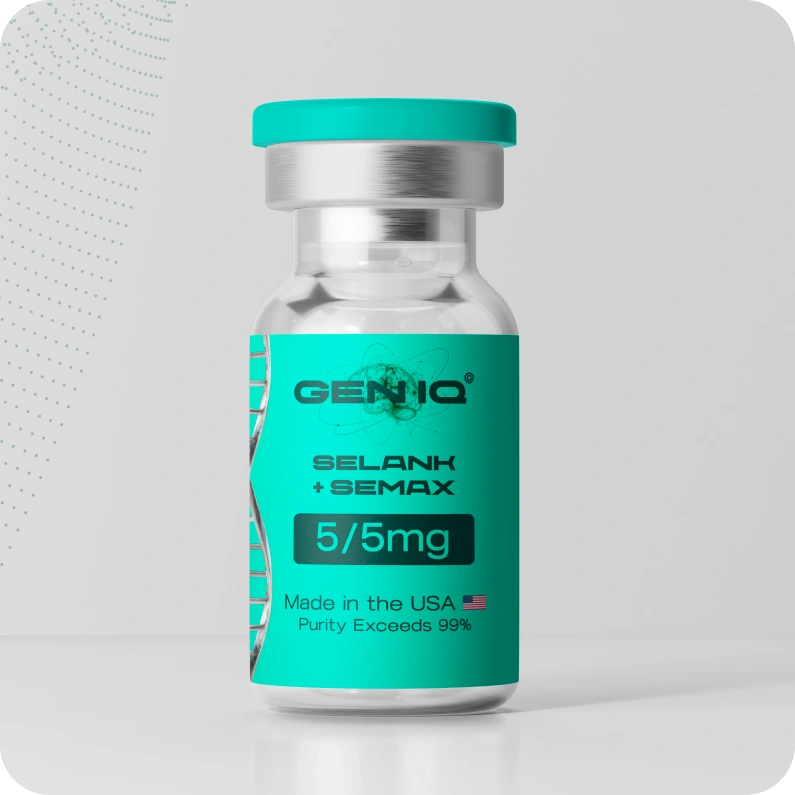

Selank + Semax (5/5mg)
For Research Use Only — Not for Human Use
Intended for laboratory research use only (e.g., analytical and in-vitro studies). Not for human use.
Selank and Semax are synthetic neuroactive peptides commonly studied in neuroscience and molecular-biology research.
Selank is derived from the endogenous peptide tuftsin, while Semax is based on a fragment of adrenocorticotropic hormone (ACTH 4–10).
When combined in research environments, these peptides are evaluated for their complementary interactions within neurochemical signaling, stress-response pathways, and cognitive-function models.
$125.99

-
 Official retailer
 -
Quality guaranteed

-
Free delivery from $99
-
Free returns is available
What Is Selank / Semax?
Selank and Semax are synthetic neuroactive peptides commonly studied in neuroscience and molecular-biology research.
Selank is derived from the endogenous peptide tuftsin, while Semax is based on a fragment of adrenocorticotropic hormone (ACTH 4–10).
When combined in research environments, these peptides are evaluated for their complementary interactions within neurochemical signaling, stress-response pathways, and cognitive-function models.
GENIQ supplies Selank / Semax strictly for laboratory research only—not for human or animal use.
Peptide Overview
The Selank / Semax combination is frequently used in studies focused on neuroregulation and central nervous system biochemical pathways.
In controlled laboratory settings, researchers examine how this peptide pairing may promote changes in:
| • Neurotransmitter-related biochemical systems |
| • GABAergic and monoaminergic signaling pathways |
| • Stress-response and adaptive signaling |
| • Memory, learning, and attention-related molecular markers |
| • Neurotrophic and neuroplasticity-associated pathways |
| • Gene-expression modulation in neuronal tissue |
| • Immune–neurochemical communication models |
| All findings are derived solely from non-clinical research environments. |
All findings remain limited to preclinical and in-vitro experimental environments.
History of Selank / Semax
Selank and Semax were developed independently by Russian peptide research institutes during the late 20th century as part of broader investigations into regulatory neuropeptides.
Selank originated from tuftsin research related to immune and stress-modulation pathways, while Semax was engineered to explore ACTH-derived neurochemical signaling without hormonal activity.
Over time, researchers began evaluating the combined use of Selank and Semax in studies involving:
| • Behavioral neuroscience |
| • Stress-adaptation mechanisms |
| • Cognitive-function modeling |
| • Neuroimmune interactions |
| • Gene-transcription and neuronal signaling pathways |
| The pairing remains widely studied due to its relevance across multiple neurobiological research domains. |
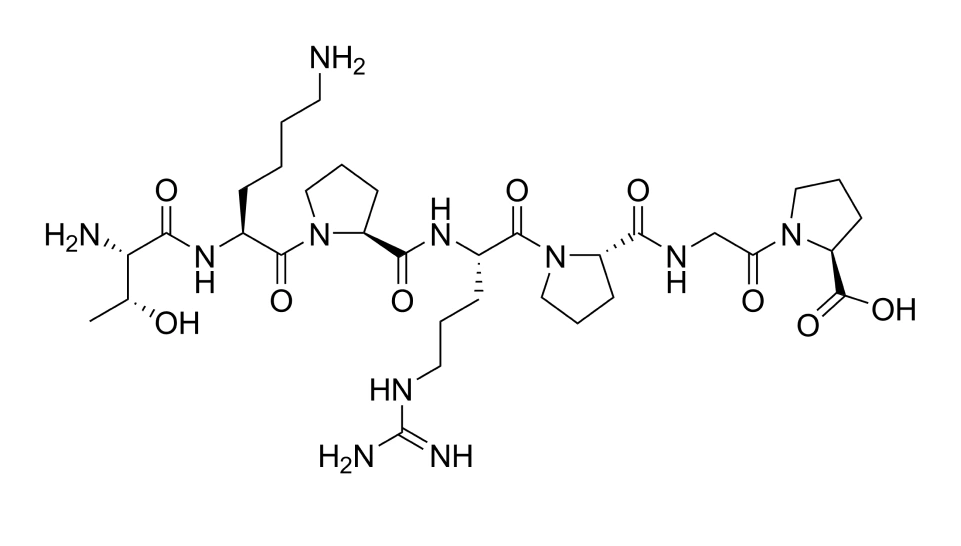
Peptide Structure
Selank Sequence: Thr-Lys-Pro-Arg-Pro-Gly-Pro
Semax Sequence: Met-Glu-His-Phe-Pro-Gly-Pro
Certificates of Analysis
Selank / Semax — 5mg / 5mg
Research Findings
Research involving Selank / Semax commonly focuses on:
| • Neurotransmitter modulation: Studies observe biochemical changes related to GABA, dopamine, and serotonin-associated pathways. |
| • Stress-response signaling: Researchers evaluate molecular markers involved in stress adaptation and resilience. |
| • Cognitive modeling: Laboratory experiments assess memory- and learning-related biochemical patterns. |
| • Neurotrophic pathways: Semax is examined for its role in BDNF-associated signaling in neuronal tissue. |
| • Gene-expression behavior: Studies track transcriptional activity related to neuroplasticity and cellular protection. |
| • Immune–neurochemical interaction: Selank is included in research exploring immune-linked neural signaling mechanisms. |
| These findings are limited to laboratory research and do not represent clinical outcomes. |
These findings reflect laboratory experiments only and do not indicate clinical outcomes.
References
2. Ivanov V., et al. “Tuftsin analogs and stress-related molecular pathways.” Neuropeptide Research Reports.
3. Gene Regulation Laboratory. “Transcriptional effects of regulatory peptides in neuronal systems.”
FAQ
Are GENIQ peptides pharmaceutical products?
No. They are not drugs, supplements, or therapeutic items. All compounds are provided strictly for laboratory research.
Who should purchase GENIQ research materials?
Qualified researchers, laboratories, and institutions working within applicable laws and regulations.
Do orders include COAs?
Yes. Each peptide includes a Certificate of Analysis confirming identity and purity testing when available for that lot.
What handling notes does GENIQ provide?
Only storage temperature and solvent-compatibility notes when listed on the product page. GENIQ does not provide guidance on preparation or application. Buyers follow their institution’s laboratory protocols.
Are these products for human use?
No. For Research Use Only — Not for Human Use. Not for human or animal consumption.
For Research Use Only — Not for Human Use
Sold exclusively as laboratory research materials. Not for human or animal consumption, clinical use, or household use.
Intended research use: Laboratory and in-vitro research, including analytical characterization and pathway / receptor-binding studies as applicable to this compound. Not for human consumption, clinical use, or diagnostic use on humans.
Selank and Semax are synthetic neuroactive peptides commonly studied in neuroscience and molecular-biology research.
Selank is derived from the endogenous peptide tuftsin, while Semax is based on a fragment of adrenocorticotropic hormone (ACTH 4–10).
When combined in research environments, these peptides are evaluated for their complementary interactions within neurochemical signaling, stress-response pathways, and cognitive-function models.
RELATED PRODUCTS