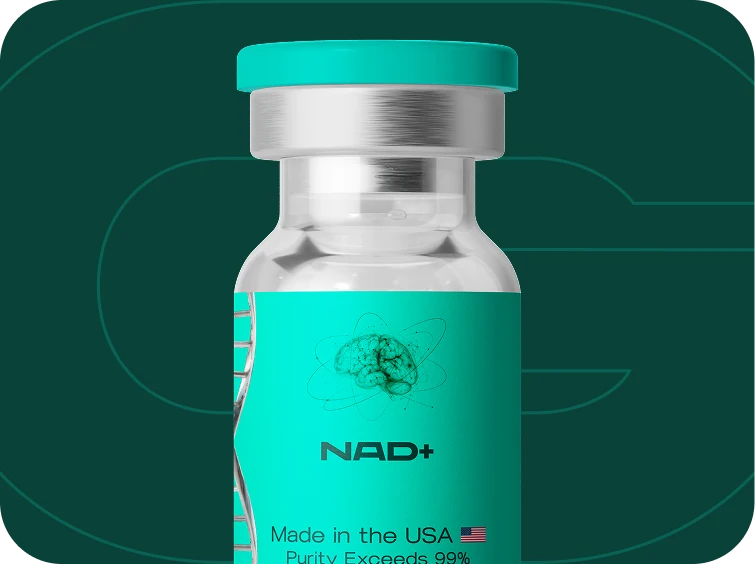

NAD+ — 500mg
Nicotinamide Adenine Dinucleotide (NAD+) is a naturally occurring coenzyme present in all living cells.
It plays a central role in energy metabolism, mitochondrial function, redox reactions, and cellular signaling.
In research settings, NAD+ is studied for its involvement in metabolic regulation, aging-related pathways, DNA-repair activity, and cellular stress responses.
$199.99
-
Official retailer
-
Quality guaranteed
-
Free delivery from $99
-
Free returns is available
What Is NAD+?
Nicotinamide Adenine Dinucleotide (NAD+) is a naturally occurring coenzyme present in all living cells.
It plays a central role in energy metabolism, mitochondrial function, redox reactions, and cellular signaling.
In research settings, NAD+ is studied for its involvement in metabolic regulation, aging-related pathways, DNA-repair activity, and cellular stress responses.
GENIQ supplies NAD+ solely for laboratory research—never for human or animal administration.
Compound Overview
NAD+ is essential for numerous biochemical processes, participating as both an electron carrier and a signaling molecule.
Laboratory investigations often examine how NAD+ may promote changes in:
| • Cellular energy production (ATP synthesis models) |
| • Mitochondrial performance and biogenesis pathways |
| • SIRT (sirtuin)–related regulatory mechanisms |
| • DNA-repair enzyme activity, including PARPs |
| • Oxidative stress and redox balance |
| • Aging and metabolic resilience models |
| • Immune and inflammatory signaling pathways |
| These interactions are observed exclusively in controlled research conditions. |
All findings remain limited to preclinical and in-vitro experimental environments.
History of NAD+
NAD+ was first identified in the early 1900s during fermentation research.
Its structure and biochemical importance were later established through decades of molecular biology studies.
Key historical milestones include:
| • 1906 — Discovery of NAD+ as a fermentation-accelerating factor |
| • 1930s — Recognition of NAD+ as a coenzyme in redox reactions |
| • 1990s — Discovery of NAD+ in sirtuin and longevity-associated signaling |
| • 2000s — Expanding research into aging, mitochondrial decline, and DNA-repair pathways |
| Due to its crucial role in fundamental cell biology, NAD+ remains one of the most heavily studied metabolic compounds in modern biomedical research. |
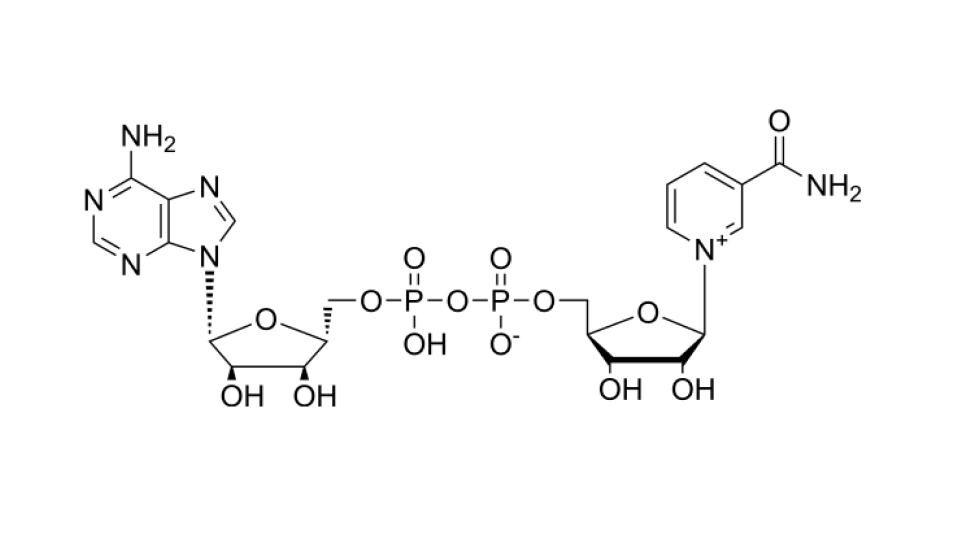
Compound Structure
Structure: C₂₁H₂₇N₇O₁₄P₂
Certificates of Analysis
NAD+ — 500mg
Research Findings
Research exploring NAD+ commonly focuses on:
| • Energy metabolism: NAD+ participates in glycolysis, oxidative phosphorylation, and mitochondrial ATP production. |
| • Sirtuin activation models: SIRT enzymes rely on NAD+ as a substrate, influencing gene regulation and metabolic adaptation. |
| • DNA repair studies: NAD+ is required for PARP enzyme activation, which participates in genomic maintenance. |
| • Aging research: Experiments examine how declining NAD+ levels correlate with age-related cellular changes. |
| • Oxidative-stress environments: NAD+ influences redox balance in cells exposed to metabolic or environmental challenges. |
| • Inflammatory signaling: Research examines NAD+ in immune-modulation and inflammatory cascade pathways. |
| Findings are limited to in-vitro and controlled non-clinical studies. |
These findings reflect laboratory experiments only and do not indicate clinical outcomes.
References
2. Imai S., et al. “Sirtuin–NAD+ interactions and metabolic regulation.” Cell Metabolism Research.
3. Mitochondrial Biology Institute. “NAD+ involvement in oxidative phosphorylation and mitochondrial performance.”
4. Genomic Integrity Laboratory. “NAD+-dependent PARP activation in DNA-repair models.”
FAQ
What type of research is NAD+ used for?
NAD+ is frequently used in studies involving metabolism, mitochondrial biology, aging pathways, DNA repair, and redox balance.
Does GENIQ provide a Certificate of Analysis?
Yes. Every GENIQ compound includes a COA confirming identity and purity.
Is NAD+ approved for human or veterinary use?
No. NAD+ is not FDA-approved and is not intended for human or animal consumption.
Does GENIQ offer reconstitution or dosing instructions?
No. GENIQ does not provide any preparation, dosing, or application guidance.
Who should handle this compound?
Only qualified researchers working within controlled laboratory environments.
Research Use Only
All GENIQ compounds are intended strictly for laboratory research.
Not for human or animal consumption, medical use, or therapeutic application.
Nothing in this document should be interpreted as medical advice or as approval for use outside controlled scientific environments.
Nicotinamide Adenine Dinucleotide (NAD+) is a naturally occurring coenzyme present in all living cells.
It plays a central role in energy metabolism, mitochondrial function, redox reactions, and cellular signaling.
In research settings, NAD+ is studied for its involvement in metabolic regulation, aging-related pathways, DNA-repair activity, and cellular stress responses.
Only logged in customers who have purchased this product may leave a review.

Reviews
There are no reviews yet.