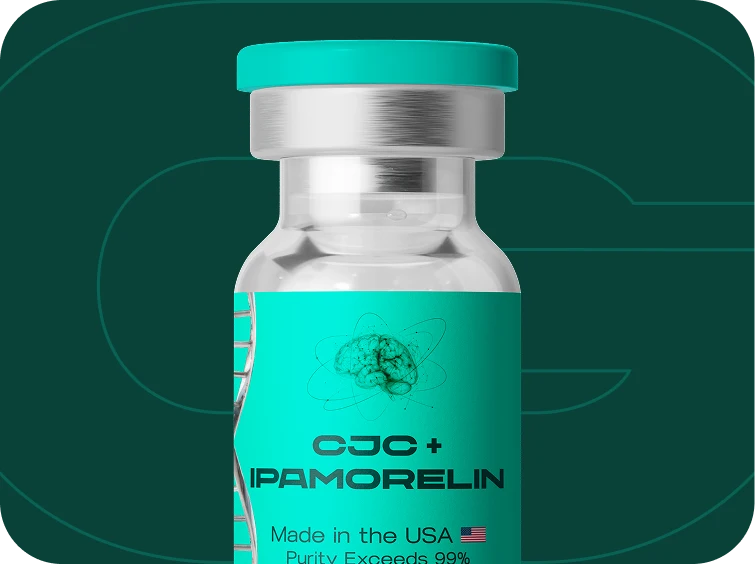
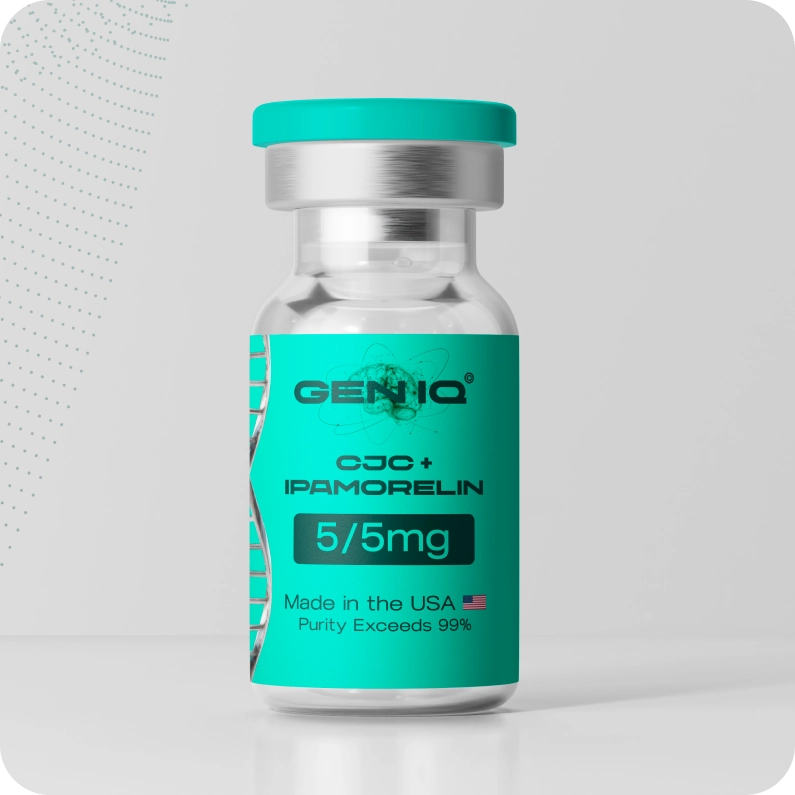




CJC-1295 (No DAC) / Ipamorelin — 5mg
CJC-1295 (No DAC) / Ipamorelin is a dual-peptide research blend combining a modified growth hormone–releasing hormone analog (CJC-1295 No DAC) with a selective growth hormone secretagogue receptor peptide (Ipamorelin).
Researchers use this combination to study the interaction between GHRH-related signaling and ghrelin-receptor pathways under controlled laboratory conditions.
This compound is provided by GENIQ exclusively for scientific research and not for human or animal use.
$139.99
-
Official retailer
-
Quality guaranteed
-
Free delivery from $99
-
Free returns is available
What Is CJC-1295 (With DAC)?
CJC-1295 (With DAC) is a synthetic peptide analog of growth hormone–releasing hormone (GHRH) engineered for research on long-acting endocrine signaling.
The “DAC” (Drug Affinity Complex) component allows the peptide to bind to albumin, extending its duration within experimental systems and enabling the study of prolonged receptor activity.
Researchers use CJC-1295 (With DAC) to investigate extended-release GHRH analog behavior, pituitary signaling cascades, and hormone-regulation modeling.
GENIQ provides this compound solely for controlled laboratory research, not for human or animal use.
Peptide Overview
This blend merges two peptides commonly used in endocrine signaling research:
CJC-1295 (No DAC):
A short-acting GHRH analog studied for its impact on pituitary receptor signaling, hormone-pulse modeling, and intracellular cascades linked to growth hormone pathways.
Ipamorelin:
A selective GHSR (growth hormone secretagogue receptor) agonist often investigated for its role in ghrelin-related cellular communication, receptor specificity, and downstream signaling mechanisms.
| Laboratory studies evaluate how this peptide combination may promote changes in: |
| • Somatotroph cell signaling |
| • cAMP pathway activation |
| • Ghrelin-receptor–mediated biochemical activity |
| • Endocrine pathway interactions under short-duration conditions |
| These findings are strictly from research environments. |
All findings remain limited to preclinical and in-vitro experimental environments.
History of CJC-1295 (No DAC) / Ipamorelin
CJC-1295 emerged from efforts to design synthetic GHRH analogs with adjustable durations. The No-DAC variant allows for short, clean receptor interactions.
Ipamorelin was developed later as a highly selective GHSR agonist with minimal interaction outside its target receptor, which made it valuable for studying ghrelin-related pathways without broad biological effects.
Researchers began pairing these peptides to investigate how simultaneous stimulation of GHRH and GHSR pathways behaves in experimental hormone-regulation studies.
The combination remains widely used for in-vitro examination of pituitary dynamics and endocrine-signaling interactions.
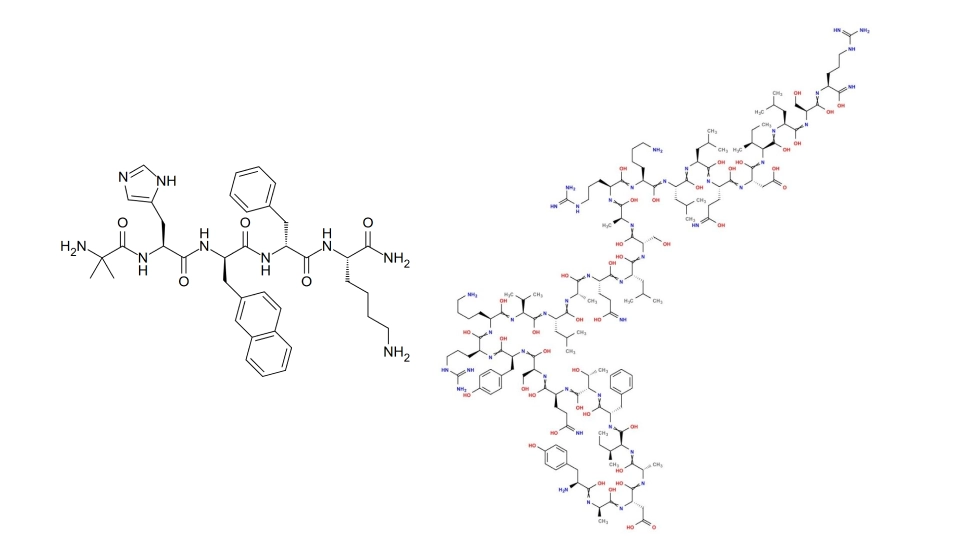
Peptide Structure
CJC-1295 (No DAC) Sequence:
Tyr-Ala-Asp-Ala-Ile-Phe-Thr-Gln-Ser-Tyr-Arg-Lys-Val-Leu-Ala-Gln-Leu-Ser-Ala-Arg-Lys-Leu-Leu-Gly-Gln-Leu-Ser-Ala-Arg-Lys-Leu-Leu-Lys
Ipamorelin Sequence:
Aib-His-D-2-Nal-D-Phe-Lys-NH₂
Certificates of Analysis
CJC-1295 (No DAC) / Ipamorelin — 5mg / 5mg
Research Findings
Research models analyzing the dual activity of CJC-1295 (No DAC) and Ipamorelin commonly explore:
| • GHRH & GHSR pathway interactions: Studying combined receptor signaling when both pathways are activated. |
| • Pituitary-cell responsiveness: Examining how somatotrophs respond to dual-peptide stimulation. |
| • Intracellular messenger activity: Including cAMP activation, downstream gene-expression changes, and receptor-signal amplification. |
| • Endocrine-pulse modeling: Using the No-DAC variant to observe short-term signaling, while Ipamorelin provides selective receptor engagement. |
| These data represent controlled in-vitro and preclinical studies, not clinical outcomes. |
These findings reflect laboratory experiments only and do not indicate clinical outcomes.
References
2. Smith R., et al. “Selective GHSR agonists and their endocrine signaling behavior.” Receptor Pharmacology Review.
3. Peptide Endocrine Consortium. “Combined receptor-stimulation models using CJC variants and GHSR agonists.”
4. Endocrine Pathway Research Unit. “Short-duration vs. long-duration GHRH analog activity in laboratory systems.”
FAQ
What type of research is this peptide blend used for?
It is used to study GHRH and ghrelin-receptor pathway interactions, pituitary signaling, and hormone-pulse modeling.
Does GENIQ provide a Certificate of Analysis?
Yes. Every GENIQ peptide includes a COA verifying identity and purity.
Is this product approved for human or animal use?
No. It is not FDA-approved and not intended for human or veterinary administration.
Can GENIQ provide instructions regarding preparation or use?
No. GENIQ does not give any guidance related to reconstitution, dosing, or application.
Who should handle this compound?
Only trained laboratory researchers in controlled scientific environments.
Research Use Only
All GENIQ compounds are intended strictly for laboratory research.
Not for human or animal consumption, medical use, or therapeutic application.
Nothing in this document should be interpreted as medical advice or as approval for use outside controlled scientific environments.
CJC-1295 (No DAC) / Ipamorelin is a dual-peptide research blend combining a modified growth hormone–releasing hormone analog (CJC-1295 No DAC) with a selective growth hormone secretagogue receptor peptide (Ipamorelin).
Researchers use this combination to study the interaction between GHRH-related signaling and ghrelin-receptor pathways under controlled laboratory conditions.
This compound is provided by GENIQ exclusively for scientific research and not for human or animal use.
Only logged in customers who have purchased this product may leave a review.

Reviews
There are no reviews yet.