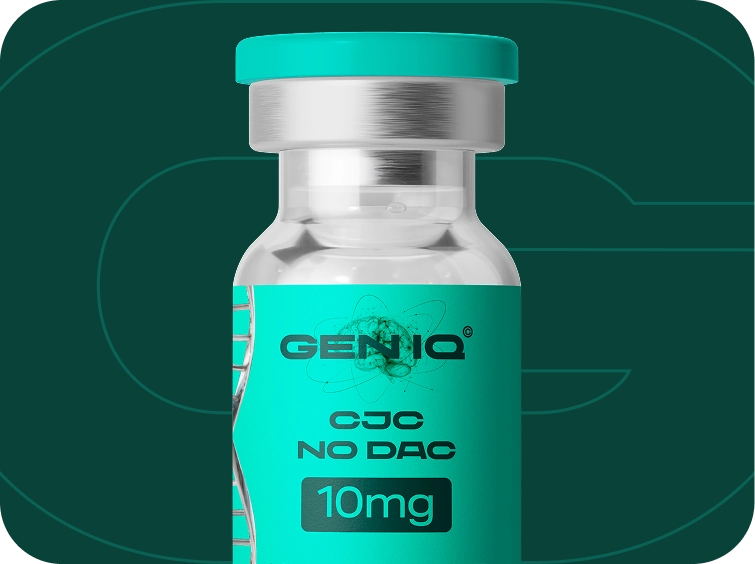
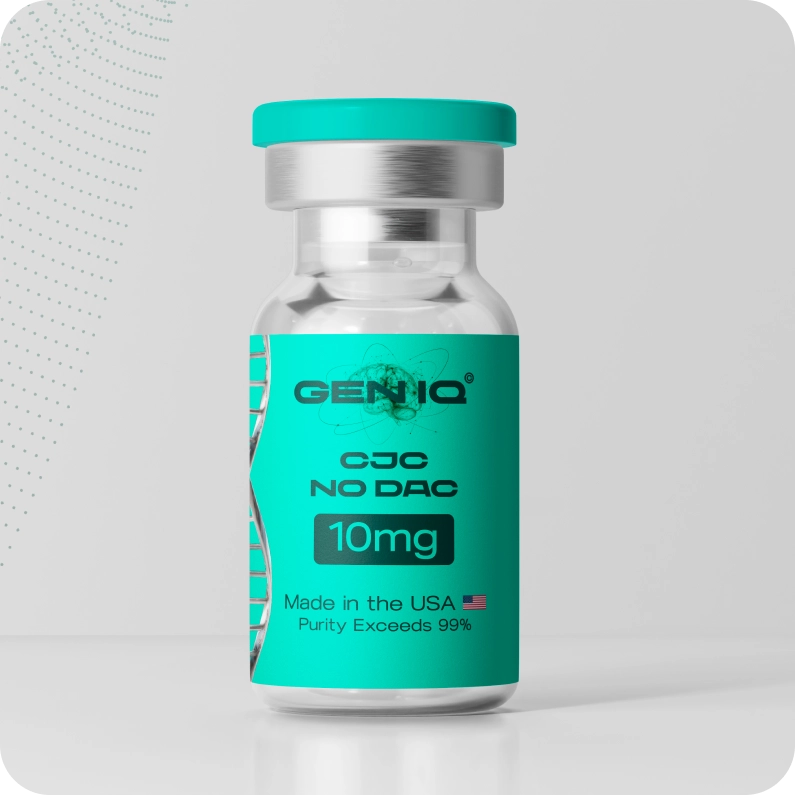
CJC-1295 (No DAC) — 10mg
CJC-1295 (No DAC) is a synthetic peptide analog of growth hormone–releasing hormone (GHRH) designed for laboratory research on pituitary signaling pathways.
The “No DAC” version means it does not include the Drug Affinity Complex, resulting in a shorter half-life and more direct examination of its raw biological activity in vitro.
Researchers study this peptide to better understand GHRH-related pathways, cellular communication, and signaling responses associated with growth hormone secretion mechanisms.
GENIQ supplies CJC-1295 (No DAC) strictly for in-vitro scientific research and not for human or animal use.
$89.99
-
Official retailer
-
Quality guaranteed
-
Free delivery from $99
-
Free returns is available
What Is CJC-1295 (No DAC)?
CJC-1295 (No DAC) is a synthetic peptide analog of growth hormone–releasing hormone (GHRH) designed for laboratory research on pituitary signaling pathways.
The “No DAC” version means it does not include the Drug Affinity Complex, resulting in a shorter half-life and more direct examination of its raw biological activity in vitro.
Researchers study this peptide to better understand GHRH-related pathways, cellular communication, and signaling responses associated with growth hormone secretion mechanisms.
GENIQ supplies CJC-1295 (No DAC) strictly for in-vitro scientific research and not for human or animal use.
Peptide Overview
CJC-1295 (No DAC) is commonly used in research settings to explore how modified GHRH fragments interact with pituitary receptors and downstream signaling.
Research models have studied:
| Growth hormone–related receptor pathways |
| Pulsatile signaling behavior |
| Interactions with somatotroph cells |
| Molecular cascades tied to anabolic signaling |
| Short-duration peptide receptor activity |
| These observations reflect controlled laboratory findings only and should not be interpreted as therapeutic implications. |
All findings remain limited to preclinical and in-vitro experimental environments.
History of CJC-1295 (No DAC)
CJC-1295 was originally developed to investigate long-acting GHRH analogs.
During early peptide engineering research, scientists created two variants:
| 1. CJC-1295 with DAC (Drug Affinity Complex) for extended half-life |
| 2. CJC-1295 without DAC for short, clean, receptor-specific signaling studies |
| The No-DAC version became widely used in research due to its ability to isolate immediate receptor interactions without prolonged activity. Since then, it has remained a staple in studies evaluating GHRH analog behavior, endocrine signaling, and biochemical communication within pituitary cells. |
Peptide Structure
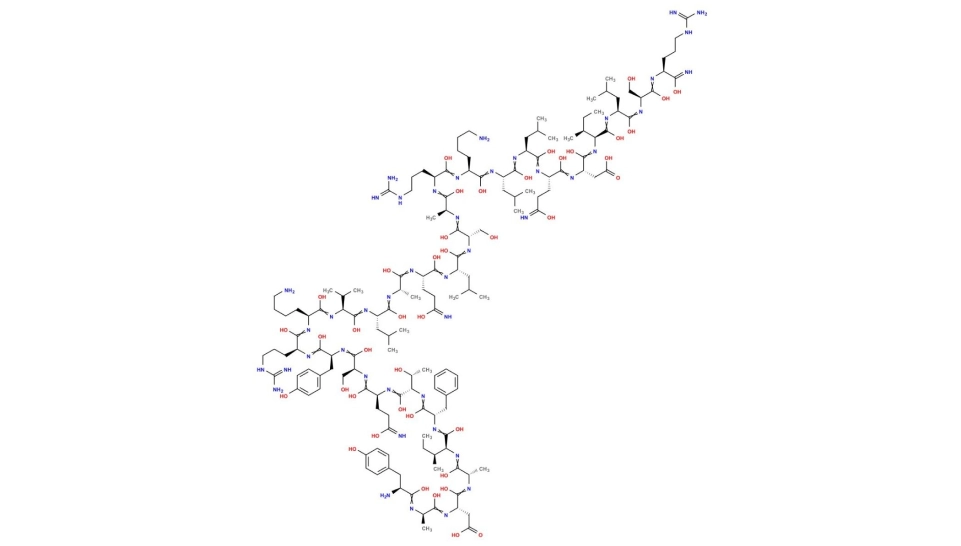
Sequence: Tyr-Ala-Asp-Ala-Ile-Phe-Thr-Gln-Ser-Tyr-Arg-Lys-Val-Leu-Ala-Gln-Leu-Ser-Ala-Arg-Lys-Leu-Leu-Gly-Gln-Leu-Ser-Ala-Arg-Lys-Leu-Leu-Lys
Certificates of Analysis
CJC-1295 (No DAC) — 10mg
Research Findings
Laboratory studies exploring CJC-1295 (No DAC) frequently focus on its influence on GHRH-related systems, including:
| Pituitary receptor activity: Research examines how the peptide interacts with GHRH receptors and somatotroph signaling. |
| Pulsatile hormone modeling: Shorter half-life peptides allow researchers to model transient signaling dynamics. |
| Intracellular cascades: Studies evaluate pathways related to cAMP, growth hormone gene transcription, and secondary messenger activation. |
| Endocrine regulation models: CJC-1295 (No DAC) is often included in research involving growth hormone axis behavior under controlled experimental settings. |
| These findings apply only to laboratory observations and are not indicative of clinical use. |
These findings reflect laboratory experiments only and do not indicate clinical outcomes.
References
2. Frohman L., et al. “Characterization of synthetic GHRH fragments and receptor signaling responses.” Journal of Molecular Endocrine Studies.
3. Research Group for Peptide Endocrinology. “Comparative analysis of DAC and No-DAC GHRH analogs in laboratory environments.”
4. Monograph on GHRH Analogs. “Signal transduction pathways examined in models using CJC-related peptides.”
FAQ
What type of research is CJC-1295 (No DAC) used for?
It is used in laboratory studies investigating pituitary signaling, GHRH pathways, and hormone-related biochemical processes.
Does GENIQ provide a Certificate of Analysis?
Yes. Every GENIQ peptide includes a COA verifying identity and purity.
Is this peptide approved for human or veterinary use?
No. It is not FDA-approved and is not intended for human or animal administration.
Does GENIQ provide preparation or dosing instructions?
No. GENIQ does not offer application, reconstitution, or dosing guidance.
Who should handle this compound?
Only trained laboratory professionals in controlled research environments.
Research Use Only
All GENIQ compounds are intended strictly for laboratory research.
Not for human or animal consumption, medical use, or therapeutic application.
Nothing in this document should be interpreted as medical advice or as approval for use outside controlled scientific environments.
CJC-1295 (No DAC) is a synthetic peptide analog of growth hormone–releasing hormone (GHRH) designed for laboratory research on pituitary signaling pathways.
The “No DAC” version means it does not include the Drug Affinity Complex, resulting in a shorter half-life and more direct examination of its raw biological activity in vitro.
Researchers study this peptide to better understand GHRH-related pathways, cellular communication, and signaling responses associated with growth hormone secretion mechanisms.
GENIQ supplies CJC-1295 (No DAC) strictly for in-vitro scientific research and not for human or animal use.
Only logged in customers who have purchased this product may leave a review.

Reviews
There are no reviews yet.